

Dreaming of a Block Island getaway for September 2026? We know that one of the first questions on your mind is likely, “How much is the ferry to Block Island?” Figuring out the different fares, routes, and extra fees can seem tricky. But knowing these costs beforehand is very important for planning a smooth trip.
In this detailed guide, we will explain all the money matters for your journey. We’ll look at today’s passenger fares for adults, seniors, and children. This includes tickets for both traditional and high-speed ferries. We will also show vehicle costs for standard cars, SUVs, and even bigger vehicles. Plus, we’ll check fees for bikes, surfboards, and pets. You will learn about key details like fuel charges, rules for canceling, and parking costs at the Point Judith dock.
Our aim is to give you a full picture of the cost of Block Island Ferry services. This will help us plan our budget well and pick the best choices for our island adventure.
Block Island, often called “The Bermuda of the North,” is a charming island destination off the coast of Rhode Island, offering a perfect escape. The primary way to reach this picturesque island is via the Block Island Ferry, operated by Interstate Navigation. They offer a range of services designed to accommodate various travel preferences and budgets.
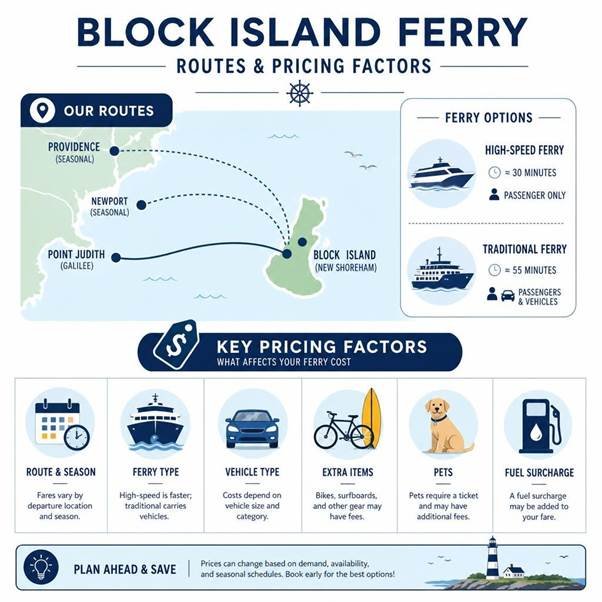
The ferry service primarily operates from Point Judith (Galilee), Rhode Island, which is the main gateway to Block Island. From here, travelers can choose between two distinct types of services: the traditional ferry and the high-speed catamaran. The traditional ferry provides a slower, more leisurely journey, typically taking about 55 minutes, and is the only option for vehicle transportation. The high-speed ferry, on the other hand, zips passengers to the island in roughly 30 minutes, offering a quicker transit for foot passengers.
In addition to the year-round service from Point Judith, seasonal routes expand the ferry’s reach. During the warmer months, typically May through October, high-speed services are also available from Newport, Rhode Island, and Providence, Rhode Island. These seasonal routes cater to a broader range of travelers, making access to New Shoreham (Block Island’s main town) even more convenient. Each route and ferry type comes with its own scheduling and pricing structure, which we’ll delve into to help you understand the nuances of planning your trip. Understanding these options is crucial for budgeting, as the choice of departure point, ferry type, and even the time of year can significantly influence the overall cost.
Complete Breakdown of the Cost of Block Island Ferry Tickets
When planning your Block Island adventure for September 2026, understanding the various components that make up your ferry ticket cost is essential. Beyond the base fare, factors like fuel surcharges, potential port fees, and seasonal variations can all impact your final bill. The route you choose and the class of service (traditional vs. high-speed) also play a significant role in determining the total expenditure. Let’s break down these costs in detail.
Passenger Ticket Pricing and the Cost of Block Island Ferry Options
The cost for passenger tickets varies based on several factors: your age, whether you opt for the traditional or high-speed ferry, and your departure point.
For travelers departing from Point Judith (Galilee), the most common route:
- Adult Fares:Traditional Ferry: A one-way ticket costs $12.30. If you’re planning a same-day round trip, the fare is $22.60. For those staying longer, a round trip on different days will cost $24.60.
- High-Speed Ferry: A round-trip ticket is $58.00. This option provides a significantly faster journey but comes at a higher price point.
- Senior Fares (65 and over):Traditional Ferry: A same-day round trip is $21.60, while a round trip on different days is $23.60.
- Child Fares (ages 5-11):Traditional Ferry: A same-day round trip is $9.30, and a round trip on different days is $10.30.
- Infant Pricing: Children under 5 typically travel free on the traditional ferry.
For seasonal routes from other locations:
- Newport High-Speed Ferry: An adult round-trip fare is approximately $51.00.
- Providence High-Speed Ferry: While specific current statistics for Providence weren’t provided, fares are generally comparable to the Newport high-speed service, catering to seasonal demand.
It’s worth noting that prices can fluctuate, and it’s always advisable to check the official Block Island Ferry website for the most current rates and to understand the full breakdown of the cost of Block Island Ferry services before booking your tickets.
For frequent travelers, the Block Island Ferry also offers “Commuter Books.” These provide a discount on multiple rides, which can be a cost-effective solution for those making regular trips to the island. While specific military or other loyalty programs weren’t detailed in our research for the Block Island Ferry itself, these commuter books serve as a valuable discount option for dedicated passengers.
Additional Equipment, Bicycle, and Pet Surcharges
Beyond human passengers, many travelers wish to bring along their gear or furry companions. The Block Island Ferry accommodates various items, but often for an additional fee.
- Bicycles: Bringing your bike on the traditional ferry is a popular choice. A one-way fare for a standard bicycle is $3.50, making a round trip $7.00. For electric bicycles, the cost is higher at $9.15 one-way and $18.30 round-trip. All bicycles are transported at the owner’s risk.
- Mopeds and Motorcycles: If you plan to bring a motorized two-wheeler, a motorcycle (and typically moped) one-way fare is $24.00, with a round trip costing $48.00. These tickets are often sold only at the terminal on the day of travel, so advance planning for these items might involve a phone call.
- Surfboards: While specific online booking for surfboards isn’t always available, they can typically be transported. The research indicates a surfboard fee of $15-$20 each way. These tickets often need to be purchased at the terminal on the day of travel.
- Pets: Block Island is a pet-friendly destination, and your companions are welcome on the ferry, with some rules. On traditional ferries, pets must be leashed or kept in a carrier. For high-speed ferries, pets are generally only allowed if they are in a carrier and remain inside the cabin. There is also a nominal dog fee, typically $5-$10 each way.
- Luggage and Personal Pallets: Standard luggage is included in your passenger fare. However, if you’re transporting larger items or excessive baggage, a “personal pallet” fee of $10.50 one-way may apply.
These additional fees can add up, so it’s crucial to factor them into your budget, especially if you’re bringing multiple items or a pet.
Understanding Fuel Surcharges and Municipal Landing Fees
Two significant, often variable, costs that impact the overall ferry price are fuel surcharges and municipal landing fees. These are not always immediately obvious but are built into your ticket price.
- Fuel Surcharge Policy: Ferry operators, like many transportation services, implement fuel surcharges to offset fluctuating fuel costs. The Block Island Ferry’s vehicle fares include a monthly fuel surcharge that changes on the 16th of each month. This means the exact amount can vary depending on when you travel, so it’s wise to check the latest rates closer to your departure date. While primarily noted for vehicle fares, these surcharges can indirectly influence passenger ticket pricing as well.
- Municipal Landing Fees: These are fees collected by the town of New Shoreham (Block Island) to help fund local services. As of September 2026, there’s ongoing discussion and proposed legislation regarding these fees. The current landing fees have not been raised since 1991. Proposed legislation would increase these fees by 50 cents per passenger (ages 12 and up), which would add $1 to a round-trip ticket. New Shoreham currently grosses about $180,000 to $190,000 annually in landing fees, with about $135,000 coming specifically from Interstate Navigation’s ferry. This revenue is vital for the island, supporting essential services like police, fire, medical facilities, and beach maintenance, especially given the influx of 20,000 to 30,000 tourists on a hot summer day. While these fees are often embedded in the ticket price, awareness of their purpose and potential changes helps us understand the broader economic context of our ferry travel.
Bringing a Vehicle: Rates, Reservations, and Policies
For many, the idea of having their own car on Block Island offers unparalleled freedom. However, transporting a vehicle on the traditional ferry is a significant expense and requires careful planning, especially during the peak summer season. The ferry service has specific vehicle classifications, reservation procedures, and strict policies that all drivers must adhere to.
Only the traditional ferry from Point Judith can transport vehicles. The high-speed ferries are for passengers only. Due to limited space and high demand, especially from June to September, advance reservations for vehicles are not just recommended, but often essential. Furthermore, Coast Guard regulations are strictly enforced, prohibiting the transport of full portable gasoline or propane tanks on passenger vessels for safety reasons.
Vehicle Transport Rates and the Total Cost of Block Island Ferry Reservations
The cost of bringing a vehicle to Block Island depends primarily on its size and type. These rates are for one-way and round-trip journeys:
- Standard Size Vehicles: This category typically includes most cars. A one-way fare is $39.60, making a round trip $79.20.
- Full-Size Vehicles: This includes larger vehicles like pickups, vans, and SUVs. The one-way fare is $48.70, and a round trip costs $97.40.
- Oversized Vehicles: If your vehicle exceeds standard dimensions, it will be charged based on its length and height.
- For vehicles under 7 feet in height, the oversized rate is $4.55 per foot one-way, or $9.10 per foot round-trip.
- For vehicles over 7 feet in height, the rate increases to $6.25 per foot one-way, or $12.50 per foot round-trip.
- There are also optional “top, front, or back add-ons” which cost $9.30 one-way. This per-foot pricing means that larger RVs, commercial vehicles, or vehicles with trailers can incur substantial costs. For example, a 20-foot RV over 7 feet tall would cost $125.00 one-way ($6.25 x 20 feet).
These rates include the monthly fuel surcharge, which, as mentioned, can change on the 16th of each month. Therefore, the exact total cost might vary slightly from the published base rates depending on the current surcharge.
Booking Policies, Standby Lines, and Cancellation Penalties
Securing a vehicle reservation is a process that requires attention to detail and adherence to specific rules:
- Advance Reservations: Vehicle reservations must be made in advance by phone. You’ll need to provide the driver’s name, vehicle details (make, model, license plate, dimensions), and a credit card for payment. It’s advisable to book well ahead of time, especially for summer travel.
- Terminal Check-in: Drivers with reservations are required to arrive at the ferry terminal at least one hour before their scheduled departure time for vehicle check-in. This allows ample time for boarding procedures.
- Cancellation Policy: Life happens, and plans change. The Block Island Ferry has a clear cancellation policy for vehicle reservations:
- If you cancel at least 7 days before your scheduled departure, you will receive a refund, minus a $12.85 cancellation fee per one-way reservation.
- Cancellations made within 7 days of departure are non-refundable. This policy is crucial to remember to avoid losing your reservation fee entirely.
- Change Policy: Changes to vehicle reservations are generally treated similarly to cancellations, with associated fees and deadlines. It’s best to contact the reservation line as soon as you know you need to make an alteration.
- Standby Information: If you don’t have a reservation or wish to take an earlier ferry, standby is an option. Standby is available on a first-come, first-serve basis and must be arranged in person at the terminal. You must remain with your vehicle in the designated standby lot. Importantly, standby can only be used to get on an earlier ferry than your originally booked time; it cannot be used to board a later ferry if you miss your scheduled departure. While it offers flexibility, standby can involve long waits, particularly during peak season, and there’s no guarantee of space.
On-Island Transportation vs. Vehicle Ferry Expenses
Deciding whether to bring your car to Block Island is a significant financial decision. While having your own vehicle offers convenience, the combined cost of the ferry transport and parking can quickly outweigh the benefits for many travelers. Let’s compare the expenses and explore alternative transportation options on the island.
The cost of ferrying a vehicle, ranging from $79.20 to potentially hundreds of dollars round-trip for oversized vehicles, is a substantial investment. For a family with a full-size SUV, the round-trip vehicle fare alone is $97.40. Add to that the daily parking costs on the mainland.
Parking at Point Judith
For those leaving their cars on the mainland, parking near the Point Judith ferry terminal is an additional expense. During peak summer, daily parking rates typically range from $20 to $30 per day. While there are several private lots in Galilee offering parking, these costs can quickly accumulate, especially for multi-day trips.
On-Island Alternatives
Block Island itself is relatively small, approximately 7 miles long and 3 miles wide. This makes it highly navigable without a personal vehicle, and there are numerous options for getting around:
- Bicycle Rentals: Renting a bicycle is a popular and environmentally friendly way to explore the island. Rental shops are conveniently located near the ferry landing. While bringing your own bike costs $7.00 round-trip on the ferry, renting one on the island can be a comparable or even more cost-effective option, especially if you’re only visiting for a day or two and want to avoid the hassle of transporting your own. Daily rental rates vary but are generally affordable.
- Moped Rentals: For those who prefer a bit more speed, mopeds are readily available for rent. They offer a fun way to cover more ground and reach various attractions. Rental prices for mopeds are higher than bicycles but still typically less than the cost of ferrying a car.
- Island Taxi Services: Block Island has a robust taxi service, with vehicles often waiting at the ferry landing. Taxis can take you to your accommodation, beaches, or specific points of interest. For groups or those with luggage, taxis can be a convenient choice.
- Shuttle Services: Some hotels and guesthouses offer complimentary shuttle services from the ferry landing. It’s worth checking with your accommodation provider before your trip.
- Walking: Many of the shops, restaurants, and immediate attractions in Old Harbor are within easy walking distance of the ferry terminal.
Comparing the total trip costs, a passenger walk-on ticket (e.g., $24.60 round-trip for an adult) combined with a bike rental (e.g., $30/day) or occasional taxi rides will almost certainly be more economical than ferrying a standard car ($79.20 round-trip) plus mainland parking ($20-$30/day). For solo travelers or couples, the savings are even more pronounced.
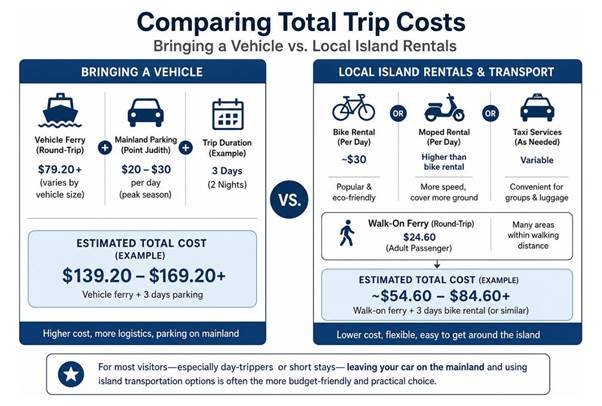
This comparison highlights that for most visitors, especially day-trippers or those staying for a short period, leaving the car on the mainland and utilizing Block Island’s local transportation options is often the more budget-friendly and practical choice.
Frequently Asked Questions About Block Island Ferry Costs
We understand that planning a trip involves many questions, especially when it comes to budgeting. Here, we address some of the most common inquiries about the cost of the Block Island Ferry and related expenses.
What is the most affordable way to travel on the Block Island Ferry?
The most affordable way to travel to Block Island is typically as a walk-on passenger on the traditional ferry from Point Judith. An adult same-day round-trip ticket costs $22.60, making it the least expensive passenger option. For children and seniors, the fares are even lower. This option also avoids the additional costs of vehicle transportation and mainland parking. Once on the island, you can save money by walking, renting a bicycle, or using local taxis sparingly. Bringing your own bicycle (for $7.00 round-trip) can also be more economical than renting one on the island if you already own one.
Can you take a car to Block Island without an advance reservation?
While it is technically possible to attempt to take a car to Block Island without an advance reservation, it is highly discouraged and risky, especially during the peak summer season (June-September 2026). Vehicle space on the traditional ferry is very limited and often sells out months in advance. If you arrive without a reservation, you would need to use the standby line. Standby is first-come, first-serve, and you must remain with your vehicle in the designated staging lot. There is no guarantee of space, and you could face extremely long waits or even be turned away if all ferries are full. For assured vehicle transport, an advance phone reservation is absolutely essential.
How much does parking cost at the Point Judith ferry terminal?
Parking costs near the Point Judith (Galilee) ferry terminal can add up, particularly during the busy summer months. While there isn’t a single official ferry parking lot, several private lots operate in the vicinity. During peak summer, you can expect to pay anywhere from $20 to $30 per day for parking. These rates can vary by lot and season, with off-season rates often being lower. It’s advisable to factor this into your budget if you plan to leave your car on the mainland.
Planning and Budgeting Your Block Island Ferry Trip
As we’ve explored, the cost of a Block Island ferry trip in September 2026 can vary significantly depending on your choices, from the type of ferry you take to whether you bring a vehicle or not. By understanding these different components, we can effectively plan and optimize our budget for an unforgettable island getaway.
Here are some key takeaways for smart planning:
- Passenger Fares: Always check the current rates for adults, seniors, and children, distinguishing between traditional and high-speed services, and whether you’re taking a same-day or different-day round trip.
- Vehicle vs. Walk-on: Carefully weigh the expense of transporting a vehicle (including high ferry fees and mainland parking) against the more economical option of walking on and utilizing Block Island’s diverse and accessible on-island transportation, such as bike or moped rentals and taxis.
- Additional Fees: Don’t forget to factor in costs for bicycles, electric bikes, surfboards, mopeds, motorcycles, and pet fees. These small additions can accumulate.
- Fuel Surcharges & Landing Fees: Be aware that vehicle fares include a monthly fluctuating fuel surcharge, and there’s a proposed legislative increase to municipal landing fees that could add $1 to round-trip passenger tickets. While often embedded, it’s good to understand these underlying costs.
- Reservations & Policies: For vehicle transport, advance phone reservations are crucial, especially during peak season. Familiarize yourself with the cancellation policy to avoid unexpected fees.
- Discounts: While the Block Island Ferry offers “Commuter Books” for frequent travelers, always check their official site for any other potential discounts or seasonal promotions.
To ensure the most accurate and up-to-date pricing and schedule information for your specific travel dates, we highly recommend visiting the official Block Island Ferry website directly. Their site provides comprehensive details that will help you finalize your plans and budget with confidence. By doing your homework and making informed decisions, you can ensure your trip to Block Island is as enjoyable as it is cost-effective.

