

Key Takeaways
- Wildfire exposure can influence insurance availability, annual costs, financing, resale appeal, and everyday preparedness.
- Hazard maps are a valuable starting point, but they do not replace property inspections or local due diligence.
- Road access, defensible space, exterior materials, and water systems all deserve careful review.
- Insurance should be investigated before an offer is submitted, not treated as a closing-day task.
- Rural properties may require added research into wells, septic systems, private roads, zoning, and backup utilities.
Wine Country buyers often begin with views, acreage, proximity to vineyards, and the character of the home. Those details matter, but wildfire exposure deserves equal attention from the first shortlist. For buyers comparing rural parcels, neighborhood homes, and vineyard-adjacent residences, Healdsburg CA homes for sale from Ceci Cook offer a useful local reference point. Ceci Cook is a California real estate associate broker serving Healdsburg, Sonoma County, the wider San Francisco Bay Area, and Wine Country. The page brings together current listings, market context, and neighborhood information for a community where property settings can vary significantly.
A home can appear similar to another property in price, square footage, and condition, yet carry very different ownership costs and practical concerns. Road access, slope, surrounding vegetation, building materials, insurance history, and nearby services can all shape the experience of owning a Wine Country home. Reviewing those factors early helps buyers make decisions based on the full picture, not just the first impression.
Why Wildfire Risk Belongs at the Start of the Search
It is easier to assess wildfire considerations before becoming emotionally attached to a particular view or floor plan. A buyer who waits until inspections are underway may discover that an otherwise appealing property has expensive insurance, limited evacuation options, or significant deferred maintenance related to vegetation and home hardening.
Wildfire considerations affect more than physical safety. They can influence homeowners’ insurance premiums and deductibles, lender requirements, renovation priorities, maintenance schedules, and the pool of future buyers. For example, two homes in the same town may have sharply different cost profiles if one sits on a broad, paved road with maintained clearance, while the other is reached by a steep, narrow driveway through dense vegetation.
Start With Official Hazard Maps
Begin by checking the exact address through California’s Fire Hazard Severity Zone information. These maps are useful screening tools because they consider factors such as terrain, vegetation, fire history, weather patterns, and expected fire behavior. They identify hazard classifications, but they do not measure every feature that may affect a specific home’s real-world risk.
During the map review and property visit, look beyond the label. Note nearby open space, ridgelines, canyons, unmanaged brush, dense tree cover, and steep slopes. Compare the online image with the home’s current condition, especially if the listing photographs were taken in another season. Also, identify at least two potential routes out of the area, if possible, and ask whether local roads have ever been closed during severe weather or fire events.
Ask Whether the Property Is Easy to Reach
Access can be one of the most important practical issues for rural and hillside homes. Emergency response and evacuation may be more complicated when a property is located at the end of a long private lane, behind a gate, over a bridge, or on a sharply graded driveway.
- Check whether roads are wide enough for vehicles to pass and whether there are usable turnarounds.
- Ask who owns and maintains private roads, gates, culverts, and bridges.
- Review shared-road agreements, annual dues, and any history of weather-related repairs.
- Confirm that house numbers and street signs are visible from the road.
- Ask how brush clearing along access routes is organized and paid for.
Review the Home’s Fire-Ready Features
No single improvement can guarantee that a home will survive a wildfire. Still, a combination of well-maintained construction details and thoughtful landscaping may reduce vulnerability to embers, direct flame, and radiant heat. The California Department of Insurance’s Safer from Wildfires framework is a helpful way to think about protection at three levels: the structure, the immediate area around it, and the wider community.
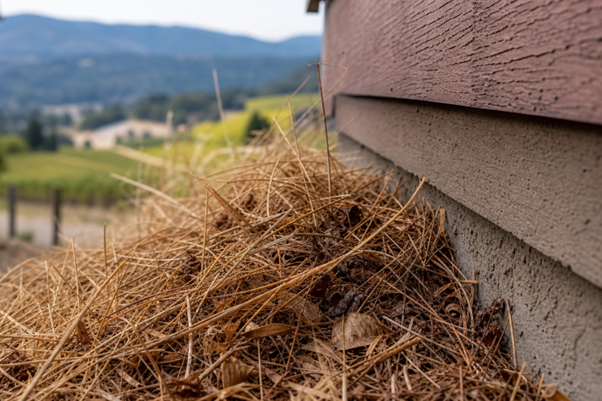
Buyers should ask inspectors and qualified contractors to evaluate the roof material and condition, vents, enclosed eaves, siding, windows, exterior doors, decks, and gutters. Pay particular attention to areas where leaves, pine needles, or other combustible debris collect. Review defensible-space maintenance records and ask whether trees, shrubs, firewood, outdoor furniture, fencing, or stored materials are positioned too close to the home.
Water storage, pumps, hydrant access, generators, and backup power are also worth discussing. These systems may be particularly important for homes served by wells or located where power interruptions are more likely. Their value depends on design, maintenance, and local conditions, so buyers should verify capacity and operating status rather than relying on a listing description.
Get Insurance Information Before Making an Offer
Insurance should be part of the pre-offer process. A mortgage approval does not solve the problem if adequate coverage is difficult to obtain or stretches the monthly budget beyond expectations. Request preliminary quotes for the specific address as early as possible, then compare both coverage and cost.
- Ask whether standard homeowners coverage is available for the property.
- Review deductibles, exclusions, limits, and separate requirements for wildfire or water damage.
- Find out whether a California FAIR Plan policy and supplemental coverage could be necessary.
- Request available information about prior claims, canceled policies, and completed mitigation work.
- Add insurance, property taxes, utilities, maintenance, and reserve funds to the ownership budget.
Look Beyond Fire Risk on Rural Properties
Wine Country homes can include acreage, vineyards, guest units, barns, private utilities, and other features that need their own diligence. Test the well water, review the production history, and inspect the septic tanks and leach fields. Confirm propane tank ownership, generator condition, electrical service, and the cost of maintaining each system.
Buyers should also review zoning, permits, easements, and allowed uses for vineyards, pools, accessory units, event areas, or agricultural structures. A scenic parcel may have conservation restrictions, shared-driveway obligations, or limitations on future expansion. These details can affect both daily use and long-term value.
A Simple Pre-Offer Checklist
- ☐ Check the official hazard map for the exact address.
- ☐ Request insurance information before submitting an offer.
- ☐ Review evacuation routes, road width, gates, and driveway conditions.
- ☐ Inspect the roof, vents, decks, windows, siding, and gutters.
- ☐ Ask about defensible space and prior mitigation work.
- ☐ Confirm well, septic, propane, generator, and electrical details.
- ☐ Review zoning, permits, easements, and private-road agreements.
- ☐ Preserve appropriate inspection and insurance contingencies.
Questions Buyers Commonly Ask
Does a High Fire Hazard Rating Mean a Buyer Should Walk Away?
Not necessarily. A rating is one important input, not an automatic answer. The appropriate decision depends on the home’s condition, insurance options, access, defensible space, price, planned use, and the buyer’s comfort with ongoing responsibilities.
Can Wildfire Risk Affect Financing?
Yes. Lenders generally require acceptable property insurance. If coverage cannot be secured or does not meet loan requirements, financing can become more complicated. Buyers should speak with their lender and insurance professional early.
What Should Second-Home Buyers Consider?
Second-home owners should plan for remote monitoring, regular landscape maintenance, backup power, emergency alerts, and a trusted local contact who can check the property during periods of elevated fire danger.
Conclusion
Buying a Wine Country home means evaluating more than views, asking prices, and finishes. A careful search considers wildfire exposure, insurance, access, construction, utilities, and long-term maintenance from the beginning. The objective is not to find a risk-free property. It is about choosing a home whose risks, protections, and ownership costs fit how it will be used.

